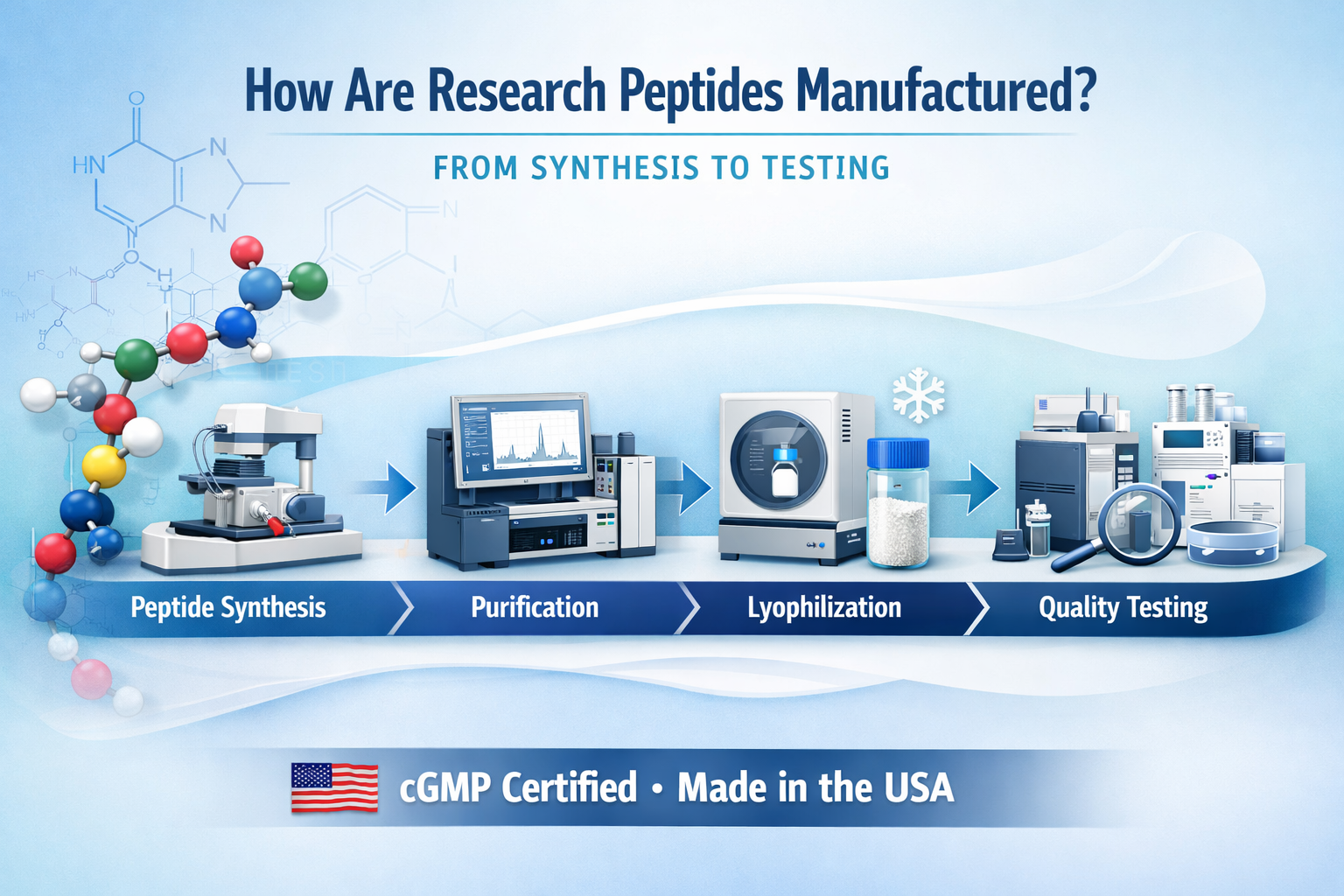
On Peptide Purity The proportion of major height to complete peaks identifies the reported pureness portion. Be cautious of COAs that give a purity number without any sustaining chromatographic information, record purity without defining the logical approach, or listing a molecular weight without mass spectrometry confirmation. This matters since peptides are built one amino acid at once via solid-phase peptide synthesis (SPPS). At each action, there's a little possibility that something goes wrong-- an amino acid doesn't affix, the incorrect modification occurs, or a side reaction generates an unintentional byproduct. Over a chain of 10, 20, or 40 amino acids, those little per-step mistake prices compound. If every action went to 100% completion, then only the unabridged peptide would certainly be produced. We incorporate LC-MS/MS and enzymatic food digestion evaluation to exactly verify the sequence and modification sites of non-natural modified peptides. Peptides, with long molecular series and diverse conformations, existing obstacles for structure verification and web content decision. BOC Sciences leverages high-resolution mass spectrometry, LC-MS/MS, and NMR to precisely evaluate molecular structures and give extremely delicate quantitative support. A solid examination record can sustain pureness, identity, and batch traceability. It does not transform a study substance right into a clinical product, and it does not change speculative validation in the scientist's own system. The peptide example is liquified in a compatible solvent and loaded right into an autosampler. The injector introduces an exact volume of sample right into the mobile-phase stream.
- Constantly check that your peptide includes correct logical information (HPLC chromatogram and MS results) and is identified for research study use.Very closely connected to truncations, removal peptides are full-length chains that are missing out on one amino acid somewhere between.Peptide pureness is an essential top quality metric that informs you what portion of a peptide sample is the intended item versus unwanted byproducts.Trusted peptide testing labs will certainly provide a suite of modern logical methods-- HPLC coupled with MS is a must, and availability of extra techniques like capillary electrophoresis or amino acid analysis is a benefit.Peptides, with lengthy molecular sequences and varied conformations, existing challenges for structure verification and material resolution.See our write-up on recognizing COAs for research study peptides as an examples making use of genuine COA frameworks.
What Is The Difference Between Hplc Purity And Mass Spectrometry Verification?
" It does not, by itself, prove that the major top is the designated peptide. An example might generate a clean-looking chromatogram with one leading optimal and still be the wrong substance if identification was never confirmed. HPLC procedures separation and relative peak location; mass spectrometry procedures mass-to-charge actions that can be used to validate molecular identification.Complimentary Testing Options
Notably, this pureness number is commonly determined after purification (e.g. by HPLC) and focuses on peptide pollutants-- it does not count residual water, salts, or counter-ions in the dried peptide powder. Simply put, the pureness percent has to do with the structure of peptide types in the sample, not the weight contribution of water or salts. If you have actually ever before obtained a synthetic peptide for a laboratory experiment, you've most likely saw a pureness percent on the certification of analysis-- typically values like 95%, 98%, or even 99%. Peptide purity is an essential quality metric that tells you what fraction of a peptide example is the intended item versus undesirable byproducts. In easy terms, a peptide provided as 95% pure is composed mainly of the target peptide (95%), with the staying ~ 5% comprised of pollutants. These contaminations can include points like reduced or trimmed sequences, deletion variations, oxidized deposits, or various other minor side-products from the synthesis procedure.Is 95% pureness great for peptides?
Peptides with an 85% purity degree or better are typically used in enzyme assays or organic task researches. Peptides with purity higher than 95% are exceptional for quantitative evaluation.