Peptide Screening: Hplc & Mass Specification Pureness Guide Pinnacle
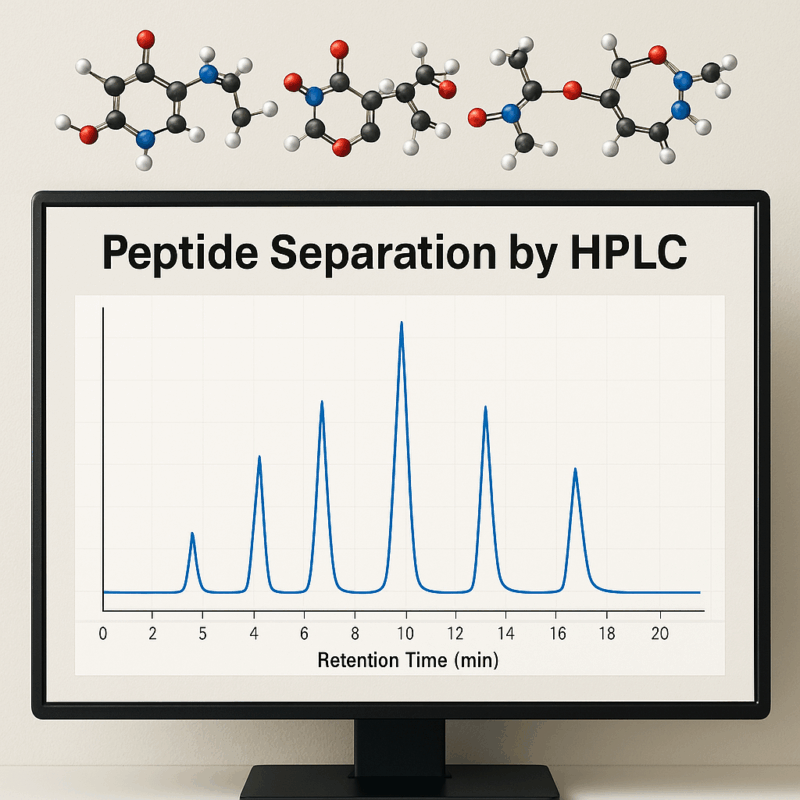
The gold criterion for determining peptide pureness is high-performance fluid chromatography, universally abbreviated as HPLC. If you see a purity percentage on a peptide product, it probably originated from an HPLC evaluation. This matters because peptides are built one amino acid each time via solid-phase peptide synthesis (SPPS). At each action, there's a little chance that something fails-- an amino acid doesn't attach, the wrong modification takes place, or a side response produces an unintentional byproduct. Over a chain of 10, 20, or 40 amino acids, those tiny per-step error prices Lyophilized Powder substance.Not every application needs 99% purity, and purification is a substantial component of peptide manufacturing cost. Trace quantities of solvents used throughout synthesis and filtration-- acetonitrile, dimethylformamide (DMF), dichloromethane-- can stay in the end product. These are typically present at extremely low levels in properly produced peptides and are controlled by ICH Q3C standards for appropriate limitations. If the target peptide's optimal represent 99.1% of the overall height location, the peptide is reported as 99.1% pure by HPLC. Numerous reputable research peptide vendors use third-party laboratories; some conduct in-house screening with publication of research laboratory qualifications.
Explore our directory to check out verified research substances and discover more regarding our testing and quality assurance process. Even small impurities can alter outcomes, reduce reproducibility, or present undesirable variables into a research study. Scientists rely on accurate, confirmed substances to guarantee their searchings for are both legitimate and consistent.Third-party Testing Vs In-house Screening
" Mass spectrometry responses "is the detected substance consistent with the desired peptide identification? " Together they offer stronger batch-level evidence than either technique alone. In the usual peptide COA context, optimal purity typically refers to the percentage of total chromatogram location represented by the primary peptide height.Sorts Of Impurities Hplc Spots
BOC Sciences offers comprehensive peptide screening services to customers across industries, guaranteeing products fulfill rigorous market demands and guaranteeing item uniformity, safety and security, and efficacy. It additionally sustains traceability-- each set's laboratory validation report can be tied to its COA and regulative filings, developing a clear paper trail. In other words, extensive lab validation is just how you prove to regulators that your peptide fulfills all top quality specifications. It aids stay clear of conformity Cellular Function issues such as stopped working audits or product recalls due to high quality problems. This not only pleases lawful requirements yet ultimately secures person security.
Notably, this purity figure is commonly figured out after purification (e.g. by HPLC) and focuses on peptide pollutants-- it does not count recurring water, salts, or counter-ions in the dried out peptide powder. In other words, the pureness portion has to do with the structure of peptide varieties in the example, not the weight contribution of water or salts. A peptide can be 98% pure (implying very couple of peptide impurities) yet still include some water or trifluoroacetate salt; those non-peptide parts would be shown in the internet peptide content as opposed to the purity portion. At Creative Peptides, we supply custom peptide chemical and physical analyses for research study groups that need dependable information on peptide identity, purity, make-up, service habits, and example high quality. Our service supports artificial, modified, cyclic, conjugated, and challenging peptide samples with logical operations constructed around the real job concern as opposed to a dealt with default panel.What To Search For In A Certificate Of Evaluation
- They likewise evaluate both raw materials and ended up peptide vials, which aids capture any type of impurities, deterioration items, or formulation disparities.HPLC separates peptides based upon their communications with a fixed stage, permitting contaminations and by-products to be determined and quantified.Peptide purity isn't simply a number on a tag-- it's a window right into the top quality of the synthetic process and a predictor of exactly how reputable your research results will be.Very closely associated with truncations, removal peptides are full-length chains that are missing one amino acid somewhere in the middle.Analytical HPLC and MS are your friends below-- HPLC quantifies purity, and MS verifies identity, together ensuring you understand what remains in your tube.